The Day I Stood in Every Wrong Place Possible 🤦♂️
Picture this: Me, three months into my pickleball journey, standing proudly at the baseline while my partner is camped out at the kitchen line. The ball comes sailing between us—about 10 feet from both of us—and we just stare at each other like two deer in headlights.
"I thought YOU had it!" "No, I thought YOU had it!"
Thunk. The ball bounces twice. Point lost. 😅
Sound familiar? Yeah, I thought so.
Here's the thing nobody tells you when you're learning pickleball: knowing HOW to hit the ball is only half the battle. Knowing WHERE to stand (and how to talk to your partner) is the other half. And honestly? For us rec players, it might be even MORE important than having a killer serve.
If you've been following along with our "Your First 30+ Days" journey, you've already conquered the rules, scoring, and etiquette (Phase 1), and you've worked through the 5 fundamental shots that got me from a 2.5 to 3.4 (Phase 2). Now? Welcome to Phase 3, my friends! 🎯
This is where things get REALLY fun—because now we're going to make sense of all that court chaos and turn you into someone who actually looks like they know what they're doing out there. 😎
Why Positioning Matters More Than You Think
Let me hit you with some real talk: I've seen players with gorgeous strokes lose game after game because they stand in the wrong spots. Meanwhile, I've watched 3.0 players with "meh" technique dominate simply because they understand court positioning.
Your positioning determines:
- How many balls you can actually reach (duh!)
- How much court you leave exposed for your opponents to exploit
- Whether you and your partner are helping or hindering each other
- How much energy you waste running around like a chicken with its head cut off
At the rec level, most points aren't won with amazing shots—they're won because someone was in the RIGHT place at the RIGHT time. Or lost because someone was standing in Narnia when they should've been at the kitchen line. 🏃♂️💨
The Golden Rule: Get to the Kitchen Line (Eventually)
Okay, here's the biggest positioning secret in recreational pickleball: The kitchen line is where you want to be... most of the time.
Notice I said "eventually" and "most of the time"? That's because blindly rushing the net is how you get destroyed by a drive to your shoelaces. Ask me how I know. 😂
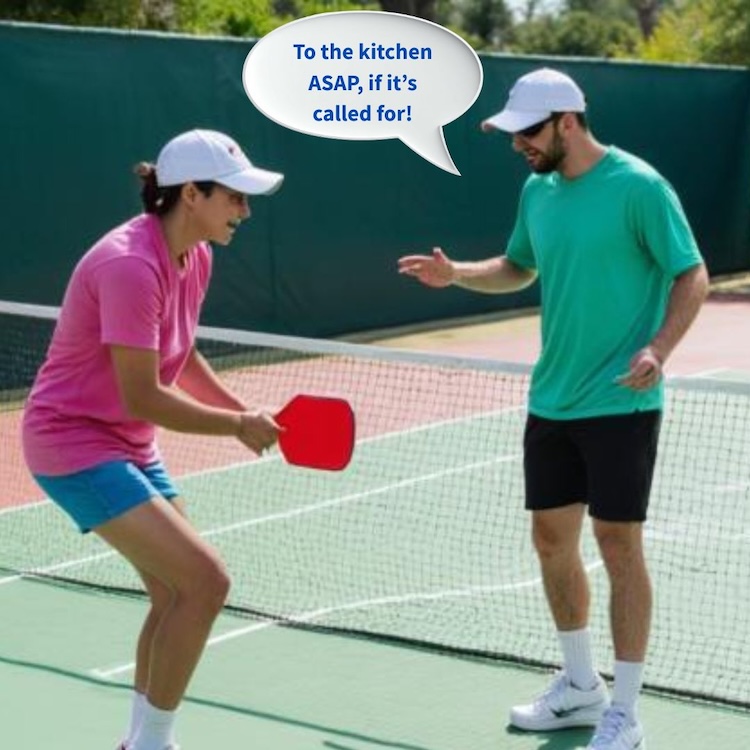 Move to the kitchen line ASAP, if that is, indeed, what's called for!
When to Move Up to the Kitchen Line:
DO move up when:
- You've hit a decent drop shot that lands in their kitchen
- Your partner is already there and the ball is under control
- The opponents are back at the baseline (they can't hurt you from there)
- You just returned their serve successfully
DON'T move up when:
- They're winding up for a big drive at the baseline
- The ball is coming at you fast and low (stay back and defend!)
- You just hit a weak, high shot (they're about to attack it—brace yourself!)
- Your balance is off and you'll be moving forward off-balance
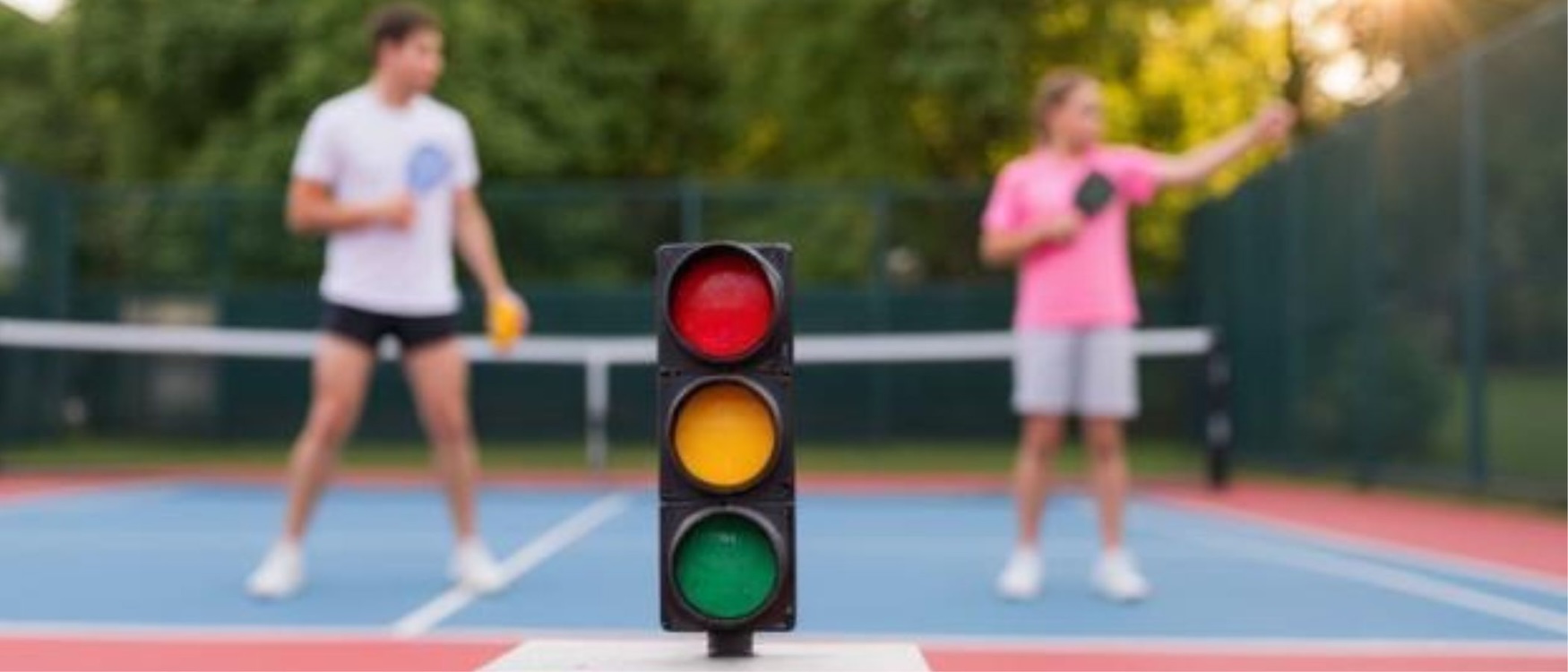
The "Traffic Light" System 🚦
Mateo taught me this awesome way to think about when to move forward:
🟢 Green Light (GO!): Both opponents are back, ball is controlled and low, partner is stable
🟡 Yellow Light (READY): Decent rally, neutral situation, look for your chance to advance
🔴 Red Light (STOP!): They're attacking, ball is high, or you're out of position—STAY PUT!
Real Talk with Monico 💬
"The traffic light system literally saved my game! I used to rush forward at the WORST times—like right after I hit a floaty lob that was screaming 'please attack me!' 🤦♂️ Got drilled in the chest more times than I care to admit. Now I actually pause for half a second after each shot and think: green, yellow, or red? It feels slow at first, but it becomes instinctive. And bonus: you look way more composed on the court when you're not sprinting forward and backward like you're doing wind sprints!"
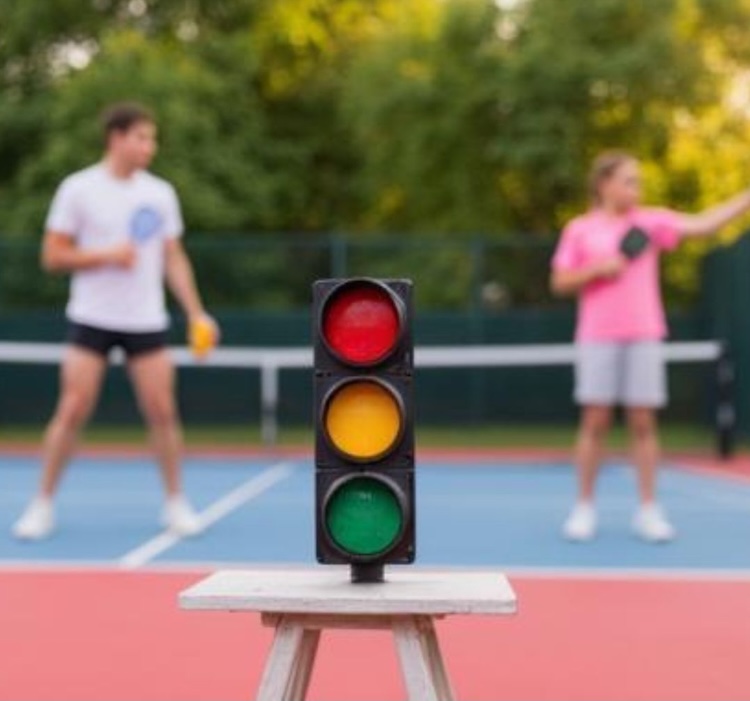 The traffic light system: Know when to go, when to wait, and when to stay put!
The Kitchen Line: It's Not Actually a "Line" 📍
Here's something that confused the heck out of me early on: when people say "get to the kitchen line," they don't mean stand ON the line like you're walking a tightrope.
The "Kitchen Line Position" actually means:
- Standing about 6-12 inches BEHIND the kitchen line (so you don't accidentally step in)
- Staying on the balls of your feet, ready to move
- Knees slightly bent, paddle up at chest height
- Eyes locked on that ball like it owes you money 👀
Think of it as your "home base" in pickleball. You should be trying to get back to this spot whenever possible, just like in tennis you want to get back to the center of the baseline.
Real Talk with Monico 💬
"Okay, confession time: For my first six months of playing, I thought 'kitchen line' meant literally standing ON the line. Like, toes touching it. I spent SO much time getting called for kitchen violations because I kept stepping in after my volleys. 🤦♂️ Once someone finally explained the 6-12 inch cushion concept, my game changed overnight. Also? That 'paddle up at chest height' thing? GAME CHANGER. I used to let my paddle drop to my waist between shots and wondered why I was always late to the ball. Keep. That. Paddle. Up!"
Partner Positioning: The "We Move Together" Dance 💃🕺
Alright, this is where it gets fun. You and your partner aren't two solo players sharing a court—you're a TEAM. A unit. A dynamic duo! (Okay, maybe I'm getting carried away, but you get the point.)
The Side-by-Side Formation
At the kitchen line, you and your partner should be:
- Side by side, like you're standing in line for tacos
- About 6-8 feet apart (not touching shoulders, but not on opposite sides of the court either)
- Both at roughly the same distance from the net
The biggest mistake I see rec players make? One partner is at the kitchen, the other is still hanging out at the baseline like they're at different parties. This leaves a HUGE gap in the middle that your opponents will absolutely punish. 😬
The "Move as a Unit" Concept
When your partner moves left, YOU move left (a little). When your partner moves right, YOU move right (a little).
You're like those synchronized swimmers, except less graceful and more focused on not letting the ball hit the ground. 🏊♀️
Why this matters: It prevents gaps in your coverage. If your partner slides over to hit a wide ball and you don't adjust, you've just created a giant hole in your defense. Your opponents aren't blind—they WILL hit it there.
Real Talk with Mateo 💬
"Here's what I see ALL the time at rec level: one person gets pulled wide for a shot, and their partner just... stands there. Frozen. Like a statue. Meanwhile, there's now a Grand Canyon-sized gap down the middle. Look, you don't have to be a mind reader—just watch where your partner goes and slide over a couple steps. That's it! You're not trying to take their shot, you're just covering the gap they left. Think of it like zone defense in basketball. When someone rotates, everyone shifts a little. Same concept, pickle-flavored!" 🏀➡️🥒
The Middle Ball Mystery: Solved! 🔍
Oh boy, let's talk about the most awkward situation in recreational pickleball: the ball that comes down the middle.
How many times have you and your partner both gone for it? Or both watched it drop between you? Yeah, me too. Many, many times.
The Middle Ball Rules (In Order of Priority):
1. The Forehand Takes It ⭐ If the ball is in the middle, the player who can hit it with their forehand should take it. Forehands are stronger and more reliable than backhands for most rec players.
Exception: If your backhand is secretly amazing and your partner's forehand is a liability, adjust accordingly. Know your team!
2. The Player Who Called It Takes It This is where COMMUNICATION comes in (more on that in a sec).
3. The Player Moving Forward/Toward It Takes It If one of you is already moving toward the ball, go for it! Don't stop mid-stride because you're being "polite."
Real Talk with Mateo 💬
"At 4.0+, the person on the left (from your perspective facing the net) typically takes middle balls because they're hitting forehands. But at rec level? Honestly, just talk it out and figure out what works for your partnership! I've played with people who have KILLER backhands and weak forehands—rules are meant to be adapted to your actual abilities, not what some textbook says. The goal is to NOT let the ball bounce twice between you, however you make that happen!" 🗣️
Communication: Your Secret Weapon 🎤
Here's something that leveled up my game IMMEDIATELY: talking to my partner.
I know, revolutionary, right? 😂
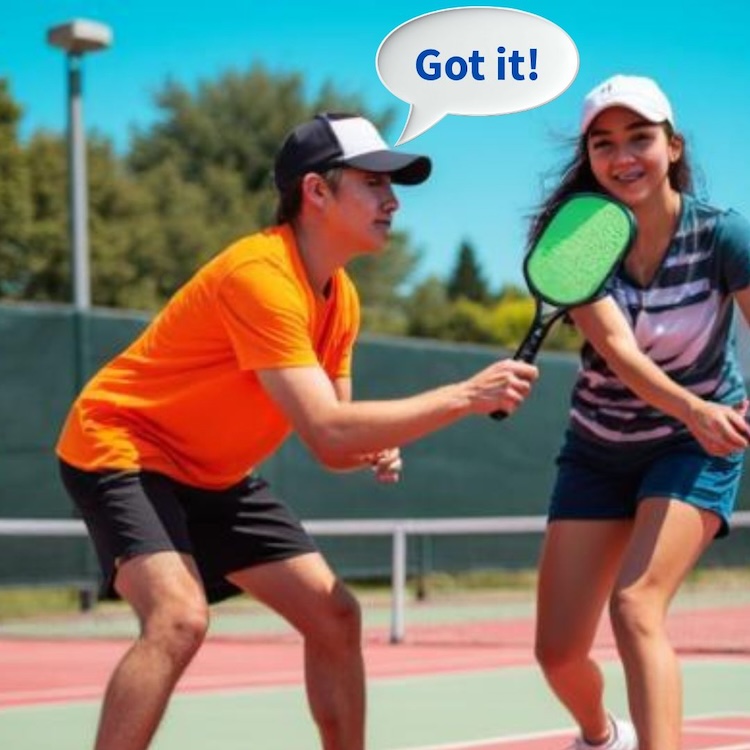 Communicate! Communicate! Communicate!
What to Say (and When):
"Mine!" or "Got it!"
- Say it EARLY and LOUDLY when you're taking the shot
- Don't be shy—this isn't the library
- Better to over-communicate than under-communicate
"Yours!" or "You got it!"
- When the ball is clearly in your partner's zone
- When you see them already moving for it
- When you're out of position or off-balance
"Bounce!" or "Let it go!"
- When a ball is going out
- Shout this BEFORE your partner commits to hitting it
- Can save a lot of points by not hitting balls that were going long
"Switch!" or "Switching!"
- When you two need to change sides to cover court better
- Usually happens after a scramble or weird shot sequence
- Helps reset your positioning
"Up!" or "Back!"
- Quick communication about positioning
- "Up!" = I'm moving to the kitchen, come with me!
- "Back!" = This one's hot, let's defend from baseline
Real Talk with Monico 💬
"Can I just say how AWKWARD it felt at first to yell on the court? I'm naturally a quiet person, and suddenly I'm supposed to be shouting 'MINE!' and 'YOURS!' like I'm auditioning for a sports movie? 😅 But you know what? After getting burned by the silent treatment about 47 times, I got over my shyness REAL quick. Now I sound like a sports announcer out there. My regular partners actually make fun of me for being too loud sometimes! But guess what? We don't have those painful 'I thought you had it' moments anymore. Worth it!"
The "I Thought You Had It" Prevention System
Before the point even starts, have a quick understanding with your partner:
- "You take forehands down the middle?"
- "I'll cover lobs on my side?"
- "Call out balls going out?"
A 5-second conversation between points can prevent a 5-minute argument after the game. Trust me. 😅
Court Coverage Zones: Who Takes What?
Let's break down the court into simple zones so you know who should be taking what shots.
Your Half of the Court (Generally Speaking):
Your Side = Your Responsibility
- Anything wide to your side is YOURS
- Don't expect your partner to sprint across the entire court
- If it's in your zone and you CAN reach it, YOU should take it
The Middle = Communication Required
- Refer back to the middle ball rules above
- When in doubt, call it out!
- Better to have both of you ready than both of you watching
Depth Coverage:
When You're Both Up at the Kitchen:
- Partner hits a ball on their side → you shift slightly to cover middle
- You hit a ball on your side → partner shifts slightly to cover middle
- Someone lobs over your head → the person it went over calls "SWITCH!" and you rotate
When One Person is Back:
- That person covers the ENTIRE baseline area for their side
- The person at the net focuses on putaways and quick volleys
- You should both be trying to get to the kitchen line ASAP (safely)
The Stacking Confusion (Don't Worry About It... Yet) 📚
You might hear advanced players talk about "stacking." It's a positioning strategy that... you know what? Ignore it for now.
Seriously.
Master the basics of side-by-side positioning first. Stacking is like trying to learn calculus before you know multiplication. We'll get there, but Phase 3 is not the time. 🙅♂️
Common Positioning Mistakes (That I Definitely Never Made... 👀)
Mistake #1: The Statue
Standing in one spot the ENTIRE point, no matter where the ball goes.
Fix: Stay on your toes, make small adjustments constantly. You should be moving even when the ball isn't coming to you.
Mistake #2: The Shadow
Following your partner everywhere they go, leaving half the court wide open.
Fix: Maintain that 6-8 foot spacing. When they move, you adjust, but you don't follow them like a puppy.
Mistake #3: The Lone Wolf
Ignoring where your partner is and just doing your own thing.
Fix: Check in with your partner between points. Quick glance to see where they are during points. Move as a unit!
Mistake #4: The Permanent Baseline Resident
Never leaving the baseline because "it's safer back here."
Fix: Practice moving forward after good drops. You WILL get burned a few times learning this—it's part of the process! The kitchen line is where the game is won at rec level.
Mistake #5: The Overeager Net Rusher
Sprinting to the net after EVERY shot, even when the opponents are teeing up a drive.
Fix: Use the traffic light system! Green light? Go! Red light? Stay back and defend!
Real Talk with Mateo 💬
"I'm gonna be honest with you—I STILL make mistake #4 sometimes, and I've been playing for years! Here's the thing: staying back at the baseline FEELS safer because you have more time to react. But you're actually making the game harder on yourself because you're giving your opponents the entire kitchen area to work with. They can drop, they can dink, they can angle shots—you're basically playing defense the whole point. Once I forced myself to get comfortable at the kitchen line (yes, I got smoked by some drives in the process), my win rate went up like 20%. The key? Pick your moments to move up using that traffic light system. Don't be reckless, but don't be a chicken either!" 🐔
Practice Drills You Can Actually Do During Open Play 🏋️♂️
Drill 1: The "Stay Connected" Drill
Goal: Move as a unit with your partner
During a casual game, focus ONLY on maintaining proper spacing with your partner. Doesn't matter if you win or lose—just practice that 6-8 foot distance and moving together. Pick a patient partner for this! 😊
Drill 2: Communication Challenge
Goal: Call out EVERY ball
For one game, you and your partner must call "mine" or "yours" on EVERY. SINGLE. BALL. Yes, even the obvious ones. It feels silly, but it builds the habit!
Drill 3: Kitchen Line Timing
Goal: Know when to move up
Hit a drop shot → count "1-2-3" → then move to the kitchen line. This builds the habit of moving forward at the right time, not too early (you'll get driven) or too late (you're stuck in no-man's land).
Drill 4: The Middle Ball Dance
Goal: Decide middle balls quickly
Warm up with your partner hitting balls down the middle. Practice the forehand-takes-it rule and calling shots early. Make it a game: whoever hesitates loses! 🎯
Putting It All Together: Your Phase 3 Checklist ✅
You know you're ready to move beyond Phase 3 when:
- ✅ You can explain where you should be standing and why
- ✅ You naturally move forward after hitting good drops
- ✅ You and your partner maintain reasonable spacing (not perfect, but reasonable!)
- ✅ You communicate on middle balls BEFORE they bounce twice
- ✅ You recognize when to stay back vs move up (using that traffic light system)
- ✅ You understand your court coverage responsibilities
- ✅ You're not standing in the same spot the entire point
- ✅ You watch your partner's positioning and adjust accordingly
Reality Check 💬
Here's the truth about positioning and strategy at the rec level: You're going to mess it up. A lot.
I still mess it up, and I'm a 3.4! Mateo STILL messes it up, and he's a solid 4.0!
The difference between a 2.5 and a 3.5 isn't that the 3.5 never makes positioning mistakes—it's that they:
- Recognize when they're out of position
- Adjust and get back to the right spot
- Communicate with their partner
- Learn from the mistakes instead of repeating them
You don't need perfect positioning to have fun and improve. You just need to be AWARE of positioning and actively working on it.
Some days you'll feel like a positioning genius. Other days you'll accidentally leave the entire right side of the court open and wonder what you were thinking. Both are normal! 😂
Your Phase 3 Action Plan 🎯
Week 1-2: Awareness
- Just start NOTICING where you and your partner are standing
- Watch better players and see how they position themselves
- No pressure to change anything yet—just observe
Week 3-4: Communication
- Implement calling "mine" and "yours" on middle balls
- Talk to your partner before points about who takes what
- Practice one communication skill per session
Week 5-6: Movement
- Work on moving to the kitchen line after good drops
- Practice the side-by-side spacing with your partner
- Focus on moving as a unit (at least attempting to!)
Week 7-8: Integration
- Put it all together in actual games
- Don't worry about winning—focus on positioning and communication
- Celebrate small victories (you both moved forward together? HIGH FIVE! 🙌)
Final Thoughts: It's a Journey, Not a Destination 🚀
Positioning and court strategy might seem overwhelming at first. I get it. When I was learning this stuff, my brain felt like it was going to explode trying to think about where to stand WHILE also trying to hit the ball.
But here's the cool thing: it becomes automatic.
Just like you don't think about how to tie your shoes anymore, eventually you won't think about positioning—your body will just know where to go. Your communication with your partner will become natural. You'll see that gap in their coverage and instinctively know to aim there.
It takes time. It takes practice. It takes patience with yourself (and your partners).
But I promise you, once this stuff clicks? Your game transforms. You'll win points you have no business winning. You'll cover shots you couldn't reach before. You'll actually FEEL like you know what you're doing out there! 🏓
And honestly? That feeling is worth all the awkward "I thought you had it!" moments along the way.
Now get out there and stop standing like a statue! Your court positioning journey starts today! 💪
Got questions about positioning or want to share your own "I was standing in the wrong place" story? Send us a note on IG.! And if you found this helpful, share it (links below) with that one partner who keeps leaving the entire baseline wide open. 😉
Up next: We'll dive into "Phase 4: (2-3 weeks) How to find the right games for your level and start building your pickleball community"
Want more beginner-friendly pickleball content? Check out our complete "Your First 30+ Days" roadmap to see how all these phases fit together, or revisit Phase 2's fundamental shots guide if you need a refresher. Join your local pickleball community & ping us for support. Local? Join our Georgetown pickleball community—we're all about practical over perfect and making this sport accessible AND fun! 🎉
Remember: Every pro player started exactly where you are now—confused about positioning, bumping into their partner, and wondering why that ball keeps dropping between them. The only difference is they kept practicing and learning. You've got this! 💚